Get started with PriceLabs now!
Want to learn what PriceLabs can do for you? See for yourself with a free trial. Get started now!
This year, Christmas Day and New Year's Day both fall on a Friday. That creates two long weekends one week apart: 25 to 27 December and 1 to 3 January. Between them are three weekday nights, Monday 28 to Wednesday 30 December. The same calendar applies in the US, Brazil, Spain, France, Germany and Italy.
Those midweek nights are where holiday revenue is won or lost. In all six markets, the typical December stay was four or five nights. Your minimum-stay settings decide whether a guest can book a stay that covers the weekend and the nights after it, or whether a short booking leaves one or two nights that nobody can book.
The risk this year is empty nights, not low prices. Last December, occupancy fell in four of the six markets, mostly where more homes came onto the market. This year, nightly rates are higher than a year ago in most markets, but the number of listings is growing again in five of the six. With more homes competing for the same guests, every empty night is harder to sell.
Last Christmas, the number of listings mattered more than price. In five of the six markets, occupancy moved in the opposite direction to supply: where listings grew, occupancy fell, and where listings shrank, occupancy rose. Italy was the only exception.
Brazil had more guests, but even more homes. Booked nights in Brazil rose 9.4% in December 2025. Available nights rose about 19%, so occupancy still fell by 4.0 points.
Lower prices did not bring the guests back. In the Balearic Islands, the average nightly rate fell 13.4%, much more than the Spanish average. Occupancy rose 2.9 points, but revenue per available night still fell 6.9%. In Italy, Germany and Brazil, nightly rates in local currency were also lower than a year earlier, and occupancy still fell.
Five of the six markets go into the holidays growing. In September 2026, revenue per available night was higher than a year earlier in the US (+11.1%), Spain (+11.1%), Brazil (+8.7%), Italy (+8.2%) and France (+6.5%). Germany was the exception, down 2.9%. Most of this growth came from higher nightly rates, not from more nights sold.
At the same time, more homes are on the market. Compared with September 2025, active listings were up 13.3% in Brazil, 8.8% in Germany, 6.2% in Italy and 5.0% in France. In the US, listings rose 4.4% between November 2025 and September 2026. Spain is the only market with fewer listings than a year ago (-3.2%).
Higher rates and more competition put pressure on occupancy. The nights most at risk are the ones that are hardest to fit into a holiday trip: the weekdays between Christmas and New Year.
Here is a simple example. One guest books from Thursday 24 to Monday 28 December. Another guest books from Wednesday 30 December to Sunday 3 January. The nights of 28 and 29 December are now empty. If the listing has a three-night minimum stay, nobody can book them.
Short bookings cause the opposite problem. A two-night booking from Saturday 26 to Monday 28 December can block a guest who wanted to stay from 24 to 29 December. Five nights was the typical December stay in the US, Spain and Brazil.
In the US, two empty nights at last December's average nightly rate of $304.45 means about $609 less revenue for one listing. Across a portfolio of 20 listings, a few gaps like this make a real difference to the holiday result.
Use longer minimum stays early, and shorter ones later. Far in advance, set minimum stays on the two long weekends close to your market's typical December stay: four nights in France, Germany and Italy, and five nights in the US, Spain and Brazil. This keeps the dates open for longer stays that also cover the midweek nights. As arrival gets closer, lower the minimum so the remaining nights can still sell.
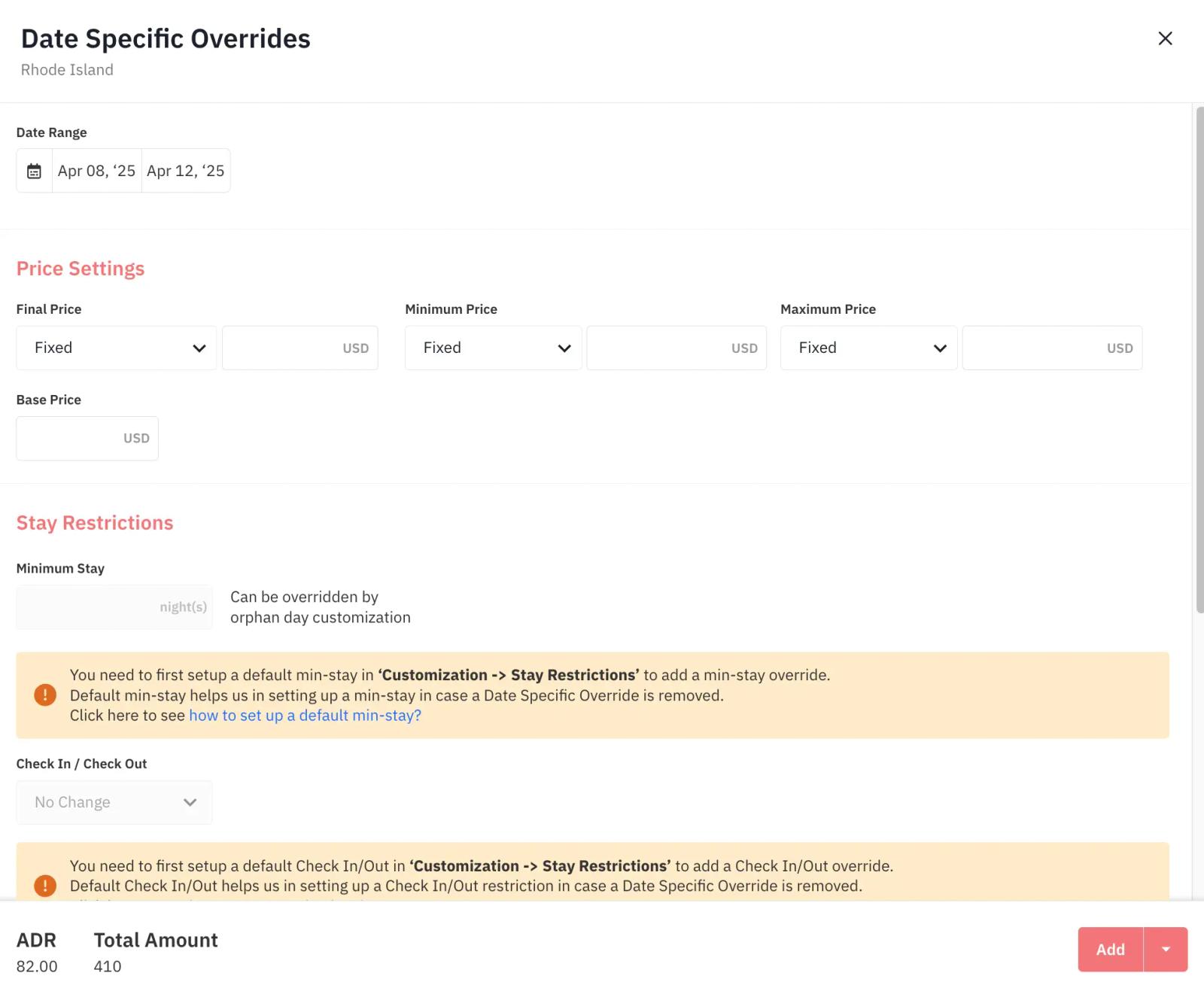
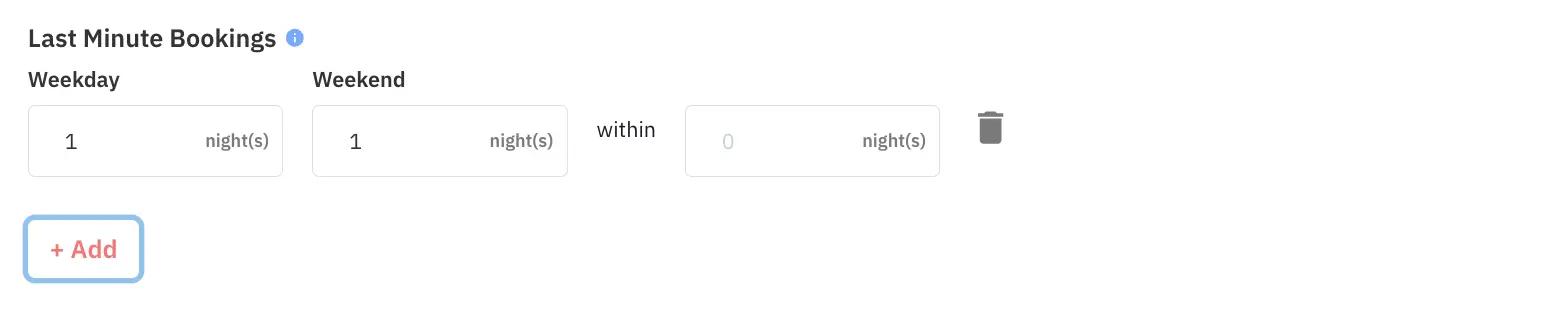
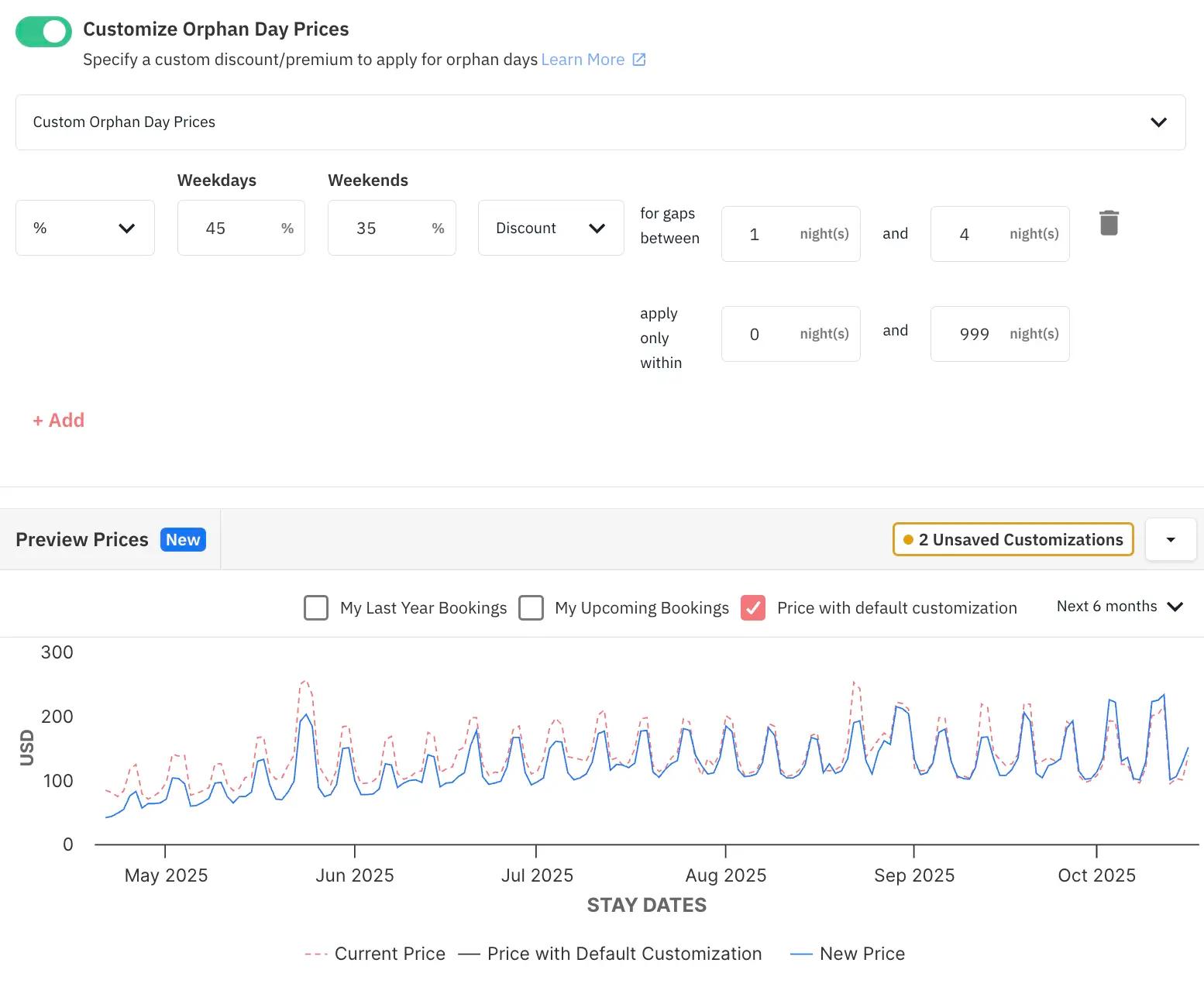
Let gap nights sell at their real length. When two bookings leave one or two empty nights between them, allow a stay of exactly that length, even if it is shorter than your usual minimum.
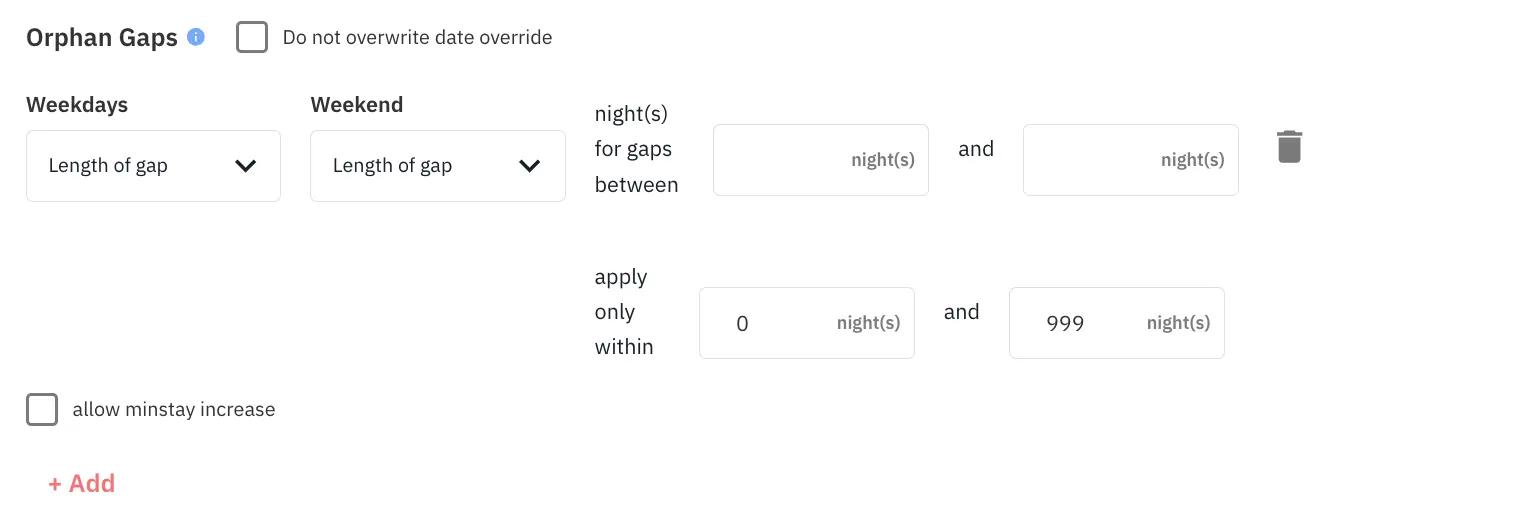
Price gap nights to sell. A Monday or Tuesday night between two holiday weekends is not worth the same as the weekend itself. A lower price on that night is better than no booking at all.
Check your arrival-day rules. Thursday 24 and Thursday 31 December are natural arrival days for the two long weekends. Make sure your check-in restrictions do not block them.
In every market, Christmas is booked earlier than the months around it. In France and Germany, the median booking window in December was about twice as long as in November or January.
The dates apply last December's median booking window to Christmas Day 2026, so they are estimates. For New Year's Eve, add six days. In Spain and Germany, the most important Christmas pricing decisions are only about a month away, so start checking each listing's booking pace against last year now.

United States. December is the only month of the year with a five-night median stay. Last December, the average nightly rate was $304.45, 1.8% higher than a year earlier, while occupancy fell 1.2 points to 45.6%. Hawaii earned the most per available night, and grew 10.4%. The ski states were split: Colorado fell 6.0% and Utah 8.1%, while Vermont, Wyoming and Montana grew.
Brazil. Christmas starts the summer high season. December had the highest nightly rate of the year (R$710.78) and January the highest occupancy (54.6%). The median stay was five nights from December to February. Beach destinations in São Paulo state, Rio de Janeiro state and Bahia earn the most per night. Of the six largest cities, only Rio de Janeiro grew last December. Listings are still growing fast (+13.3% in September 2026), so occupancy is the main risk.
Spain. Spain was the strongest market last Christmas. Occupancy rose 2.1 points to 52.0%, helped by 14.0% fewer listings, and the Canary Islands ran at 77.1% occupancy. The season is also longer. Monday 7 December 2026 is a public holiday in Andalusia, Aragon, Asturias, Cantabria, Castile and León, Extremadura, Madrid, Murcia and La Rioja, which gives these regions a four-day weekend from 5 to 8 December 2026. In other regions, including Catalonia, Valencia, the Balearic Islands and the Canary Islands, 7 December is a working day. Epiphany (Reyes) on Wednesday 6 January 2027 extends demand after New Year.
France. December was France's strongest winter month, and occupancy rose 0.7 points to 48.9%. Christmas-market cities had the highest occupancy of any market with 500 or more listings: Colmar at 85.4% and Strasbourg at 83.5%. Paris gained 6.2 points of occupancy. School holidays cover the last two weeks of December, and the median stay was four nights. Listings are up 5.0%, so there will be more competition than last year.
Germany. Germany is the weakest of the six markets. Occupancy fell in 15 of 16 states last December, and Bremen was the only state where it rose. Christmas markets open around the first Sunday of Advent, which is 29 November 2026, so city demand starts early. December stays were booked about 25 days ahead, roughly twice as early as other winter months. Listings are up 8.8%, and January is the weakest month of the year, at 39.1% occupancy.
Italy. Italy has the lowest winter occupancy of the six markets (37.9% in December), and guests book the latest: the median December booking window was 19 days. Immacolata on Tuesday 8 December 2026 makes 5 to 8 December a long weekend for guests who take Monday off, and Epifania on Wednesday 6 January 2027 extends the season. Mountain resorts such as Cortina d'Ampezzo and Livigno led last December. Rome was the only large city where occupancy rose. Listings are up 6.2%.
Lower prices still have a role at Christmas. Gap nights between bookings, and nights that are still empty in the last few days before arrival, should be priced to sell. What did not work last year was cutting rates on the main holiday dates. In the Balearic Islands, a 13.4% lower nightly rate brought 2.9 points more occupancy and still 6.9% less revenue per available night.
The two long weekends have the strongest demand of the season. This year, holiday revenue depends on the three nights between them.
Christmas Day and New Year's Day both fall on a Friday, so most guests will plan trips around the two long weekends. The weekday nights from 28 to 30 December are the hardest to fit into a trip, and short bookings or long minimum stays can leave them empty.
Far in advance, set it close to your market's typical December stay: four nights in France, Germany and Italy, and five nights in the US, Spain and Brazil. Shorten it as arrival gets closer, and let gap nights sell at their real length.
Not on the main holiday dates. In the Balearic Islands last December, a 13.4% lower nightly rate brought 2.9 points more occupancy and still 6.9% less revenue per available night. Use lower prices for gap nights and for nights still empty in the last few days. Our revenue management guide covers the wider approach.
Last December, the median booking window ranged from 28 days in Spain to 19 days in Italy. Applied to Christmas Day 2026, about half of bookings would come after 27 November in Spain and after 6 December in Italy.
All figures come from PriceLabs market research data (national monthly figures from November 2024 to September 2026, plus regional and city data for December 2024 and December 2025), pulled on 23 October 2026. US figures are in US dollars ($), figures for Spain, France, Italy and Germany in euros (€), and figures for Brazil in Brazilian reais (R$). Rates are never compared between countries.
The data tool converts values from US dollars at each month's exchange rate, so year-over-year changes in nightly rates and revenue per available night can include some exchange-rate effect, especially for Brazil. Occupancy, length of stay, booking window and listing counts are not affected by exchange rates. City figures cover destinations with at least 500 active listings (1,000 for Brazil). The "half of Christmas bookings" dates are estimates based on last December's median booking window.
Public holiday dates come from the official 2026 calendars: the national and regional labour calendar for Spain published in the Boletín Oficial del Estado, and the national public holidays of Italy, Germany, France, Brazil and the United States. Product screenshots show example PriceLabs screens; the figures in them are not the data in this article.
Want to learn what PriceLabs can do for you? See for yourself with a free trial. Get started now!