Get started with PriceLabs now!
Want to learn what PriceLabs can do for you? See for yourself with a free trial. Get started now!

Short term property management is a service business with a margin problem built into it. You collect a percentage of somebody else's booking revenue, and you absorb almost all of the operational cost of producing that revenue. Whether the business works comes down to a handful of decisions most managers make in their first year and then never revisit: which fee model to run, which properties to accept, when to hire, and how much of the operation to automate.
This guide works through those decisions with a cost model you can run on your own numbers.
Short-term rental property management is the paid operation of furnished rental properties on behalf of their owners, usually for stays ranging from one night to a few weeks. The manager handles listing distribution, nightly pricing, guest communication, cleaning and turnover, maintenance, regulatory compliance, and owner payouts, in exchange for a commission on bookings or a fixed monthly fee.
The comparison people reach for is long-term letting, and it misleads them.
| Long-term letting | Short-term rental management | |
|---|---|---|
| Transactions per year | One tenancy | Roughly 100 to 150 separate stays |
| What you sell | A twelve-month lease | A different night at a different price |
| Cleaning | Between tenancies | Between every stay, inside a six-hour window |
| Who absorbs the labor | Mostly the tenant | Almost entirely you |
| Revenue per unit | Lower | Higher |
| Cost of producing it | Low and predictable | High and variable |
| What kills the business | Vacancy | Cost to serve exceeding the fee |
A short-term manager sells the same asset three hundred separate times a year, and every one of those sales carries a cleaning, a check-in, a message thread, and a review that changes the price of the next sale. That asymmetry is why fee structure matters more here than in almost any other property services category.
Two readers. The first is evaluating whether to build a management company, or has fewer than five units and wants to know whether the model scales. The second already runs a book of properties and wants to know what breaks next. Sections are marked where the advice diverges.
The work of a property manager divides into six recurring responsibilities. What follows is a map of where the hours go, because the hours are what your fee has to cover.
Every property needs live, accurate, differentiated content on each channel you sell through, and each channel ranks it differently. Airbnb rewards calendar freshness, response speed, and field completeness. Booking.com rewards a different mix. Managers who write one description and syndicate it everywhere lose visibility on at least one channel without ever seeing why. Our listing optimization guide covers what each channel actually reads.
Rates move with seasonality, day of week, lead time, local events, and how the calendar is pacing against the same period last year. Doing this by hand for one property is tedious. For twelve it is not possible at a standard worth charging for, which is why automated dynamic pricing stops being optional somewhere around the fifth unit.
Pre-booking questions, arrival instructions, in-stay problems, and post-stay reviews. Volume scales linearly with unit count and it does not respect office hours. This is the first function most managers outsource, and knowing your ideal guest profile reduces the volume more than any templating exercise, because the wrong guest in the wrong property generates most of the difficult messages.
A clean has to fit between a late checkout and an early check-in, in the same window every other manager in your market needs their cleans done. This is where most management companies actually fail, so it gets its own section below.
Monthly statements, payouts, expense tracking, and separated accounts for money that is not yours. Managers underrate this until an owner asks a question they cannot answer quickly.
Permits, zoning, fire inspection, business licensing, and remittance of transient occupancy taxes. You are usually the party the municipality holds responsible, whoever holds the deed.
For a shorter operational rundown, see our practical guide to managing short-term rentals, and for the failure modes, the breakdown of common management challenges.
Cleaner reliability is the most common operational failure in this business, and most guides mention it without treating it.
Independent cleaners and small crews usually outperform large commercial contractors, because commercial contractors price for weekly office work and struggle with a two-hour turnaround window. Referrals from other operators in your market are the strongest channel, followed by local community groups. Cleaning marketplaces work as a backstop and rarely as a primary source, since the person who accepts the job changes between bookings and consistency is the thing you are buying.
Pay for a first clean at full rate and inspect it yourself against a written checklist. Confirm insurance and legal work status. Then test the thing that actually matters, which is not cleaning quality but responsiveness: send a same-day schedule change and see how long the reply takes. A slow reply in week one becomes an uncovered Saturday in month six.
Keeping a second crew warm means giving them enough regular work to stay available, which usually means splitting your turnovers rather than holding one crew in reserve for free. Assume that split costs you a few percent in per-clean rate plus some coordination overhead. Set that against one same-day cancellation: you refund the stay, you lose the night, and you take a review that suppresses conversion on that listing for months. Run the comparison once with your own numbers and the answer stops being a judgment call.
Photo-verified checklists submitted before a cleaner closes out a job are the baseline, because they create a timestamped record and change behavior on their own. Add a rotating physical inspection so roughly one turnover in ten gets walked, weighted toward your highest-rate units. Track cleanliness mentions in reviews per property rather than per cleaner, since a low score often reflects worn linen or a failing appliance rather than the person who cleaned last. Remote operators can run this whole loop without being on site, and our guide to remote vacation rental management covers the rest of the setup.
At five units you know every cleaner by name. At fifty you are running a vendor network, which means written rate cards, a defined escalation path, and someone whose job includes calling the backup crew. The failure mode shifts from a bad clean to an unassigned one.
Before tooling, before hiring, before you take a single owner call, decide how you get paid. The model determines your break-even unit count, your risk exposure, and which owners you can realistically win.
You take an agreed percentage of what the property books. Your income moves with performance, which aligns you with the owner and makes revenue management a direct contributor to your own margin rather than a service line. Most professional managers run this model.
A fixed amount per property per month regardless of bookings. Cash flow becomes predictable and seasonality stops mattering to you, although you have handed away all the upside from a strong summer and you will struggle to justify the fee to an owner during a soft one. The cost model below shows what this costs you: at a flat fee, a 5% improvement in realized rates adds nothing at all to your revenue, because every dollar of it belongs to the owner.
A reduced percentage plus itemized charges for defined work, typically onboarding, photography coordination, or maintenance supervision. This is the model most managers drift into once they have been burned absorbing setup costs on a property that churned in month four.
A narrower scope at a lower rate. You run listings, pricing, and guest messaging while the owner keeps cleaning and maintenance. Low commitment, low margin per unit, and a reasonable way to test a market before you commit field staff to it.
You lease the property yourself and sublet it short-term with the landlord's written permission. This is not management, since you are the operator and the tenant, and your downside is the lease payment on an empty unit rather than a smaller commission. Treat it as a different business with a different risk profile, and never blend arbitrage units into a management portfolio without separating the accounting.
Full-service management is commonly quoted between 20% and 30% of gross booking revenue, with co-hosting and marketing-only arrangements below that band and luxury or hard-to-reach markets above it. Treat any single "industry average" with suspicion, because nobody surveys this category rigorously and the published figures come mostly from operators with an interest in where the number lands.
Two details do more damage than the headline percentage.
The fee basis. A 25% commission on gross booking value is a materially different number from 25% on net revenue after platform fees and taxes are stripped out. Define the basis in the agreement before you discuss the percentage.
The one-time charges. Onboarding, photography, and listing setup are real costs to you and should be itemized rather than swallowed. Our breakdown of property manager fee structures works through the arithmetic behind each model.
If you are earlier than fee-setting, the plan comes first, and four sections of it carry real weight.
Write down what is included at your headline rate and what is billed separately, because this becomes your contract and your pricing page at the same time.
Divide your fixed annual costs by what one unit contributes after its own software cost. The cost model below computes this directly, and the answer surprises most people: at the settings used in the worked example, six units cover the fixed costs and thirteen are needed before the owner draws a normal salary.
Name the property type, market, and owner type you are built to serve. A plan that accepts everything produces an operation good at nothing.
Decide where owners come from before you need them, since referral pipelines take months to build and cold outreach converts slowly. Our ten-step launch sequence covers entity setup and market selection, and if you are coming at this from hosting your own property first, starting an Airbnb business is the earlier step.
Range tables teach nothing because nobody's portfolio is a range. Here is one portfolio carried all the way through, then the same model with every field editable.
Assume a twelve-unit portfolio in a mid-sized leisure market. Assume each unit books $52,000 of gross booking revenue a year, a 22% commission on gross, and a $300 onboarding fee on the four units taken on this year. Every figure is an assumption you should replace, and none of it is a claim about what any market delivers.
| Line | Calculation | Annual |
|---|---|---|
| Portfolio gross booking revenue | 12 units x $52,000 | $624,000 |
| Management commission | $624,000 x 22% | $137,280 |
| Onboarding fees | 4 units x $300 | $1,200 |
| Total management revenue | $138,480 |
| Line | Calculation | Annual |
|---|---|---|
| Guest communications assistant | 25 hrs/week x $12/hr | $15,600 |
| Operations coordinator | 20 hrs/week x $22/hr | $22,880 |
| Property management system | $8/unit/month x 12 x 12 | $1,152 |
| Revenue management software | $12/unit/month x 12 x 12 | $1,728 |
| Cleaning and task software | flat subscription | $1,500 |
| Insurance, licensing, accounting | $6,000 | |
| Marketing and owner acquisition | $9,000 | |
| Direct booking site and payment processing | $3,600 | |
| Total operating cost | $61,460 |
Cleaning is excluded because it is billed to the guest and paid to the cleaner. If you mark it up, that markup is revenue and belongs in the table above.
$138,480 minus $61,460 leaves $77,020 before you pay yourself, which is $6,418 per unit per year or about $535 per unit per month.
Only $2,880 of that $61,460 scales with unit count. Everything else is fixed, which is the single most important fact about this business and the reason the scenarios below behave the way they do.
Revenue falls to $94,800. Costs do not move. Contribution falls to $33,340, which is $2,778 per unit. You cut the fee by seven points and lost almost 57% of your margin, because your cost base is anchored to unit count rather than to your rate. Undercutting on percentage is the most expensive way to win an owner.
Commission rises by $45,760. Costs rise by roughly $14,000 once you add assistant hours and software seats. Contribution rises by $31,760, and per-unit contribution climbs from $6,418 to $6,800. Margin improves with scale until you cross a step cost, which for most managers is the first full-time hire.
Gross rises by $31,200 and contribution rises by $6,864, against no additional cost. That is worth roughly one extra unit you never had to onboard, and it is the reason pricing sits at the center of the operation rather than at the edge of it.
Switch the model to a flat fee and run that third scenario again. The improvement is still there, and none of it reaches you.
Operational advice that ignores portfolio size is advice for nobody. Four rough stages, with what breaks first at each.
One caution on the tiers. They describe complexity, not headcount, and twelve identical urban apartments are a simpler operation than five scattered mountain cabins with hot tubs. Count problems, not doors.
Four layers, in the order most managers should adopt them.
Buy the layer that removes the most of your own hours, not the layer that sounds most sophisticated. For a solo manager at eight units that is almost always pricing and messaging, and almost never hardware. Our automation guide covers the sequencing in more depth.
Owner acquisition is a sales problem and most managers approach it as a service problem. The pitch that loses is a description of everything you will do. The pitch that wins is a specific claim about this property, in this neighborhood, at this time of year, backed by data the owner cannot pull themselves.
The structure that works in an owner meeting:

Step one is a filter, not a report. In Market Dashboards you set the comparison set to the owner's bedroom count, property type, and radius, then read occupancy and average daily rate for that set across the next twelve months. The value to the owner is the filtering: any listing site shows them what neighbors charge, and almost none show what neighbors actually book at, segmented to properties like theirs.
Step three is where the meeting turns. Reading the same view by month rather than in aggregate usually surfaces a specific window where the comparison set holds rate and the owner's property does not, or where minimum-stay settings are blocking two-night gaps the market is filling. That is a named problem with a date range attached, which is a different conversation from promising better marketing. Our analytics guide covers how to read that data before you put it in front of anyone.
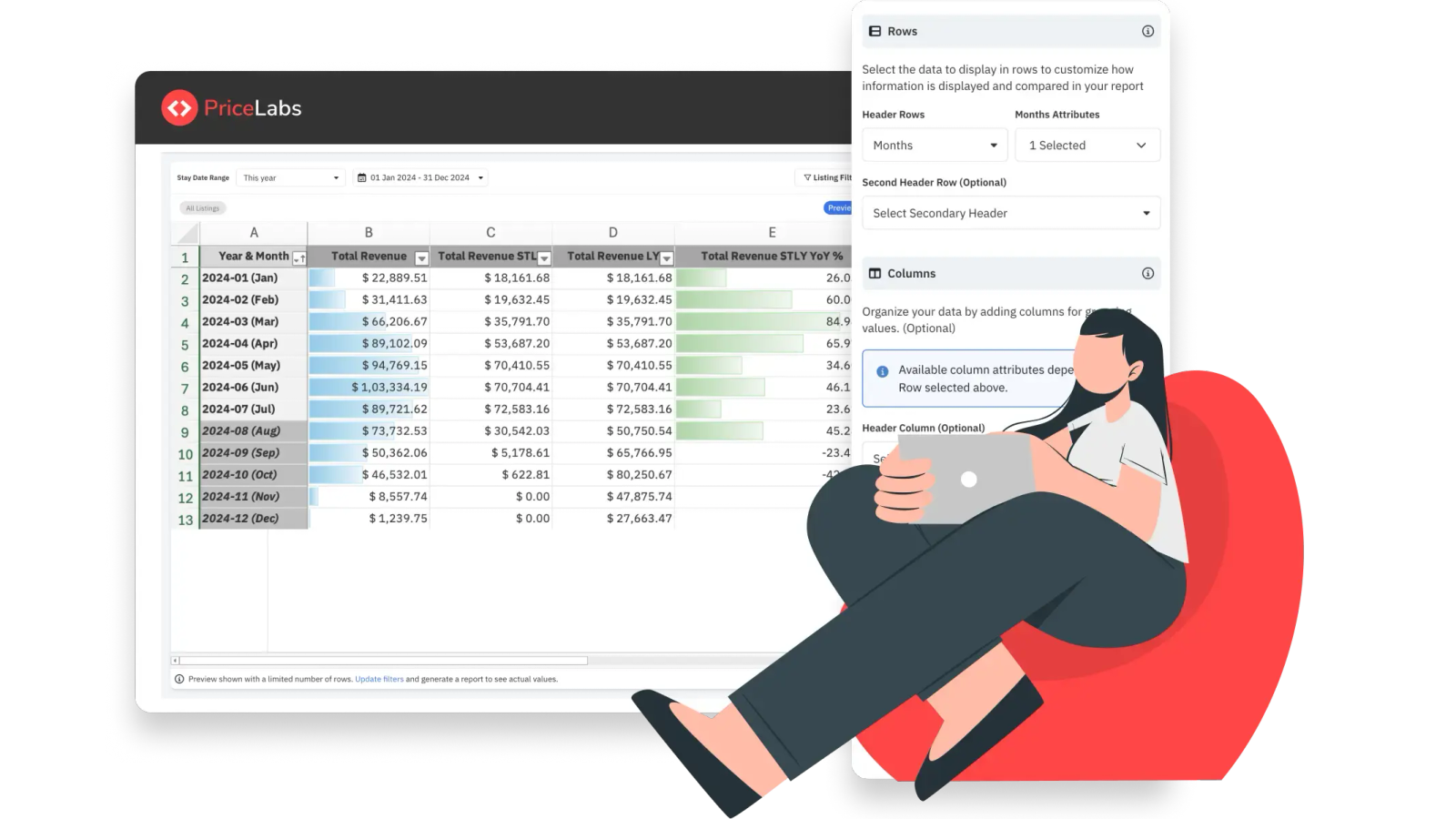
After signing, the same discipline runs monthly. Portfolio Analytics generates the owner-facing report rather than you rebuilding it in a spreadsheet, and the useful move is showing the owner their property against the same comparison set you pitched them on. A soft month reads very differently when the owner can see the whole market was soft and their unit held rate better than the set did.
Retention is a separate discipline from acquisition and gets less attention than it deserves. Owners leave over silence more often than over performance, and a manager who explains a soft month before the statement arrives keeps the contract that a manager who explains it afterwards loses. Our piece on proactive owner communication covers reporting cadence, and the guide to data-driven reporting covers what to put in front of owners monthly. Where owners have genuinely different goals, from maximizing revenue to protecting personal-use dates, use per-owner pricing strategies rather than one setting across the portfolio.
For filling the pipeline rather than closing it, see property management lead generation, and for channel and brand work, our vacation rental marketing strategies.
Managing property you do not own carries obligations that hosting your own does not.
Five patterns, in rough order of damage.
Manage them as a repeatable operation rather than a series of individual decisions. Automate pricing and guest messaging first, build a cleaning schedule with a named backup, put every property on one calendar through a property management system, and confirm permits and insurance before a unit goes live.
Full-service management is commonly quoted between 20% and 30% of gross booking revenue, with co-hosting arrangements lower and luxury or remote markets higher. The percentage matters less than the basis it is calculated on and what services it includes, so define both in writing before negotiating the rate.
Work backwards from your cost stack. Divide fixed annual costs by what one unit contributes after its own software cost, then add your target income and divide again. At the settings in the worked example, six units cover fixed costs and thirteen support an $80,000 draw. Change any input and the answer moves substantially.
Independent cleaners and small crews outperform commercial contractors on the two-hour turnaround window. Source through operator referrals and local community groups. Pay for a first clean at full rate, inspect it against a written checklist, confirm insurance, then test responsiveness with a same-day schedule change before you rely on anyone.
Commission ties your income to performance, so revenue work pays you directly. A flat fee gives predictable cash flow and hands every gain from better pricing to the owner. Run both models in the calculator above with your own numbers, because the break-even unit count differs sharply between them.
Four sections carry the weight: your service scope and what is billed separately, your break-even unit count calculated from fixed costs divided by contribution per unit, the property and owner profile you are built to serve, and where owners will come from. Everything else supports those four.
It depends on your jurisdiction. Some US states require a real estate broker license to manage property for compensation, others exempt short-term rental management specifically, and many municipalities add an operator permit on top. Check state law and local ordinance separately, since satisfying one does not satisfy the other.
Four layers, adopted in order: a property management system for calendars and payments, revenue management software for nightly rates, operations software that turns bookings into cleaning tasks, and smart access hardware. Buy whichever layer removes the most of your own hours first, which is usually pricing and messaging.
Fee basis and percentage, service scope, expense authority thresholds, personal-use blackout rules, insurance requirements, termination notice, and what happens to forward bookings when the contract ends. That last clause is the one managers most often omit and most often regret. Have a local lawyer draft it.
Start with owners who already know you, since referral converts faster than cold outreach at every portfolio size. Bring market data for their specific property to the first conversation rather than a service description. Expect the pipeline to take months, and build it before you need the revenue.
A manager operates someone else's property for a fee and carries no lease obligation. An arbitrage operator leases the property, pays rent regardless of occupancy, and keeps the whole booking revenue. The manager has lower upside and lower downside, and the two models need separate accounting even when one company runs both.
For choosing a marketable listing name and broader marketing fundamentals, see our guide to vacation rental home names. For guest-facing standards and maintenance, see our maintenance and inspection checklist. For day-to-day operational tooling, see our booking extranet deep dive. And for niche property types and where the industry is heading, see our vacation rental technology trends guide.
For filling your owner pipeline, see our dedicated guide to property management lead generation, and for a complete grounding in marketing fundamentals, see our complete vacation rental marketing guide.
Yes, provided you have reliable local vendors, keyless access, photo-verified cleaning checklists, and a defined escalation path. What does not travel is judgment about a property you have never walked through, so most remote operators still inspect on onboarding and rotate physical checks after that.
A few more areas worth exploring: naming your property well (see our guide to vacation rental home names), building a full marketing plan (see our complete vacation rental marketing guide), managing day-to-day bookings (see our deep dive on the booking extranet), and staying ahead of the curve (see our guide to vacation rental technology trends).
Want to learn what PriceLabs can do for you? See for yourself with a free trial. Get started now!